WATER DAMAGE RESTORATION NYC
Kitchen Water Damage Restoration in Brooklyn
Water Damage Restoration NYC provides kitchen water damage restoration in Brooklyn for appliance leaks, overflows, wet cabinets and damaged flooring. We trace water beneath appliances and toe-kicks, determine what can be saved, and verify drying before repair, with an estimated 1–2 hour arrival.
Kitchen Water Damage Response
1–2 Hour Estimated Arrival
Kitchen Moisture-Footprint Inspection
Cabinet and Flooring Salvage Decisions
Drying Verified Before Repair
Warning Signs in Kitchens
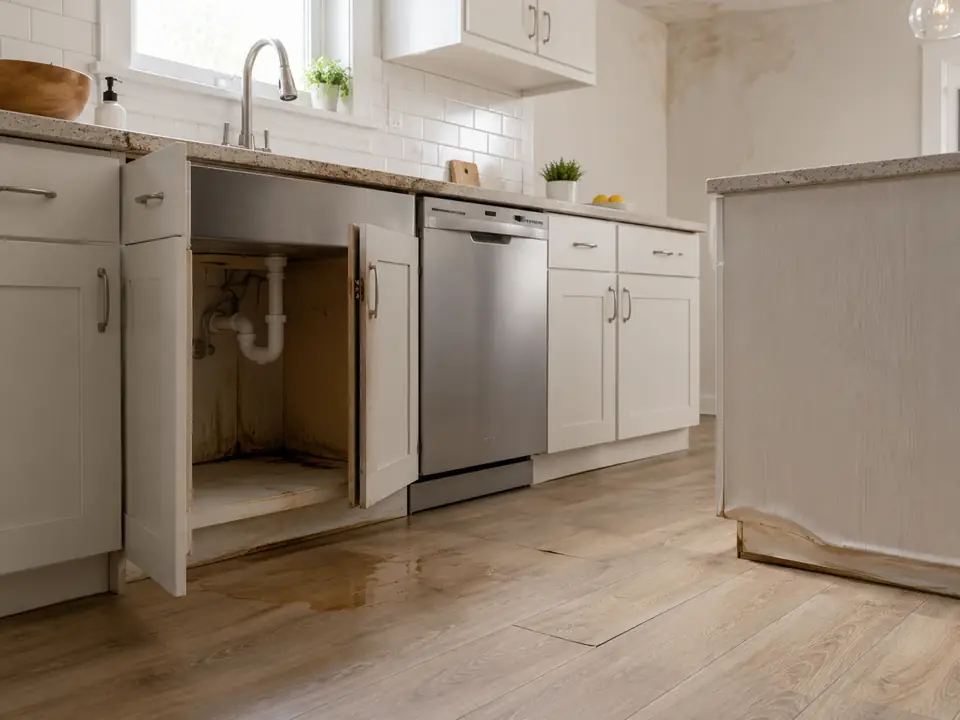
Kitchen water damage often spreads farther than the visible puddle because cabinets, appliances and continuous flooring conceal the water path.
Arrange an inspection when you notice:
- Water beneath a dishwasher or refrigerator
- Wet flooring around the sink base
- Swollen cabinet bottoms
- Soft or distorted toe-kicks
- Darkening at cabinet seams
- Laminate or engineered flooring lifting
- Hardwood cupping beside an appliance
- Water appearing from beneath cabinets
- Damp drywall behind a sink or appliance
- Swollen baseboards
- A persistent damp odor
- Water crossing into an adjoining room
- Ceiling staining in the room or apartment below
- Bubbling or peeling paint
- Brown or yellow staining
- Soft drywall
- Swollen baseboards
- Damp plaster
- Cracking around a previously wet area
- Warped trim
- A wall that feels unusually cool or damp
- Water appearing at the floor-wall joint
- A musty odor near one section of wall
- Staining that returns after repainting
- Moisture around pipe penetrations
- Water entering from the ceiling and continuing down the wall
A kitchen floor can appear dry while water remains beneath an appliance, cabinet base, underlayment or subfloor.
Composite woods and laminated materials can swell or deteriorate after absorbing water, while wood, plywood and built-up floor assemblies may retain moisture beneath the exposed surface.
If water is around electrical outlets, appliances or electrical connections, avoid using the affected equipment until its condition can be evaluated safely.
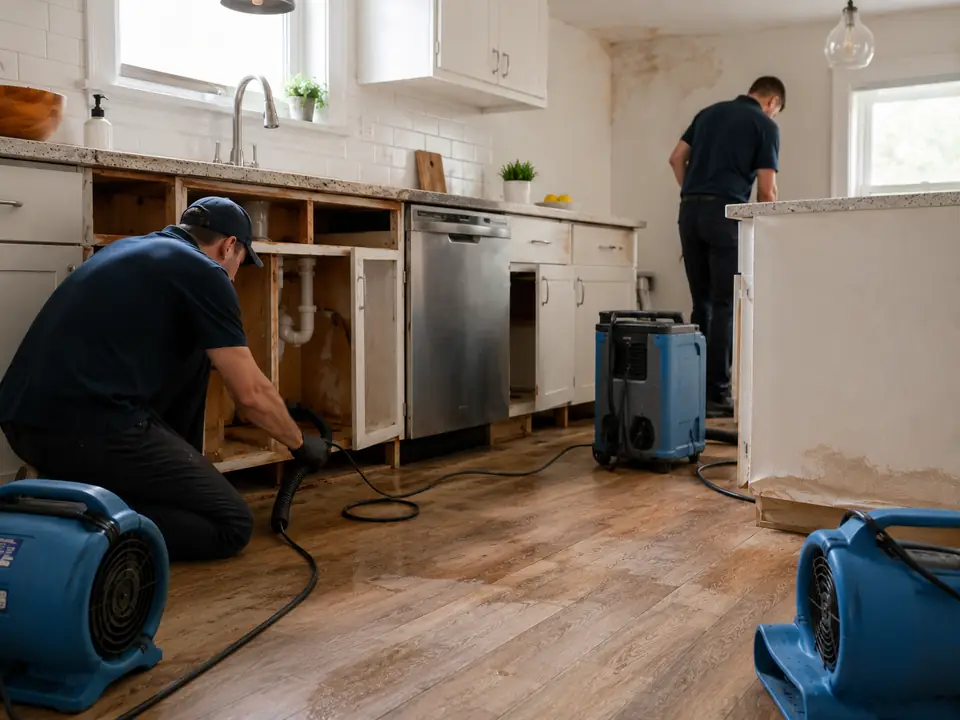
How We Inspect the Full Moisture Footprint
The visible wet area is only the starting point.
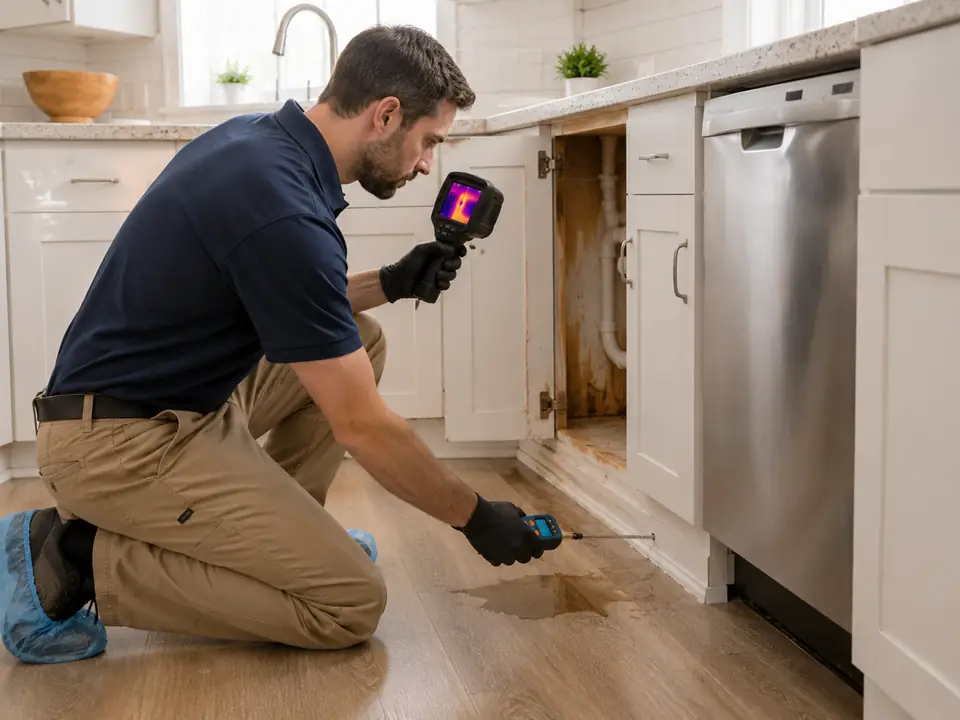
Water Damage Restoration NYC follows the kitchen construction to determine where moisture could have traveled.
The inspection can include:
- Dishwasher recess
- Refrigerator recess
- Sink-base cabinet
- Toe-kick cavities
- Cabinet end panels
- Island bases
- Flooring seams
- Underlayment
- Accessible subfloor
- Wall-floor intersections
- Drywall behind cabinets
- Baseboards and thresholds
- Adjoining rooms
- Ceiling below where relevant
- Drywall or gypsum board
- Plaster
- Lath
- Stud framing
- Insulation
- Base plates
- Baseboards and trim
- Pipe penetrations
- Wall-floor joints
- Adjoining walls
- Flooring beside the wall
- The room or unit on the opposite side
A dishwasher leak, for example, can begin inside the appliance recess, travel underneath cabinet toe-kicks and enter continuous flooring before it becomes visible in the open kitchen.
The water source also changes the restoration decision.
A recent supply-line leak has a different starting condition from dishwasher discharge, wastewater or outside floodwater. Water-damage classifications distinguish clean supply water from more contaminated appliance discharge, groundwater and grossly unsanitary flood or sewage sources.
That source-to-material relationship determines what can be cleaned, dried or retained.
Can the Kitchens Be Saved?
In many losses, large parts of the kitchen can remain. The decision should be made component by component, not by assuming the entire kitchen must be demolished because one appliance leaked.
Dry-in-Place Conditions
Kitchen materials may be retained when:
- The water source has been controlled
- The water condition permits salvage
- Cabinet boxes remain structurally stable
- Plywood has not substantially delaminated
- Wood components remain sound
- Flooring can release trapped moisture
- The subfloor can be dried
- Wall materials remain stable
- Moisture conditions show continued drying progress
Solid wood, suitable plywood, framing and some hard surfaces may be dried when their physical condition remains acceptable.
The supporting material matters as much as the visible finish. EPA guidance specifically advises checking that underflooring is dry when hard flooring has become wet.
Removal Conditions
Selective removal becomes more likely when:
- Cabinet bases are severely swollen
- Particleboard or composite material has lost its shape
- Plywood layers have separated
- Toe-kicks conceal standing or trapped water
- Flooring blocks access to a saturated underlayment
- Drywall behind cabinetry has deteriorated
- Wet insulation cannot be adequately dried
- Appliance recesses cannot be accessed
- Contamination makes porous materials unsuitable for retention
- Repeated wetting has weakened the material
A damaged toe-kick may need to come off without removing an entire cabinet run.
Likewise, flooring beneath one appliance may require access while unaffected flooring outside the moisture boundary remains in place.
Contamination Conditions
Kitchen sanitation becomes especially important when the water is not a clean internal supply leak.
Dishwasher discharge can contain contaminants, while sewage and floodwater create a substantially different cleanup condition. Water categories can also deteriorate depending on time and environmental conditions.
If floodwater reaches food or food-preparation areas, food-contact decisions must be treated separately from structural drying. FDA guidance advises discarding food in non-waterproof packaging that contacted floodwater and cleaning and sanitizing affected food-contact surfaces before reuse.
Drying and Restoration Method for Kitchens
1. Stop the Water Source
The appropriate plumber, appliance technician or other trade controls and repairs the dishwasher, refrigerator line, sink plumbing or other source.
Water Damage Restoration NYC handles the resulting property damage.
2. Remove Accessible Water
Standing water is removed from the exposed kitchen floor and accessible areas.
This limits further migration but does not establish that the material underneath cabinets or flooring is dry.
3. Inspect Appliance Recesses
Dishwashers and refrigerators can conceal the starting point of a leak.
Where accessible, we inspect beneath and around the affected appliance and follow moisture toward cabinetry, flooring and walls.
4. Check Cabinet Bases and Toe-Kicks
Toe-kicks can hide water beneath otherwise normal-looking cabinets.
We evaluate lower cabinet components for:
- Swelling
- Separation
- Softening
- Finish damage
- Trapped moisture
- Access requirements
The objective is to determine whether the cabinet can remain while the area beneath it dries.
5. Inspect Flooring and Subflooring
Water can pass between hardwood boards, beneath vinyl or laminate, through grout transitions and into underlayment or subflooring.
EPA guidance emphasizes that wet supporting flooring must also be dried rather than simply restoring the exposed surface.
6. Create Selective Drying Access
When fixed cabinetry or flooring traps moisture, limited access may be required.
Removal is based on what prevents effective restoration—not on automatically stripping the kitchen.
7. Dry Retained Materials
The drying plan addresses the materials actually holding water, which can include:
- Cabinet plywood
- Wood framing
- Subflooring
- Hardwood
- Concrete
- Drywall
- Wall plates
Built-up wood, masonry and multilayer assemblies can hold moisture more deeply and may require longer or more targeted drying than exposed surfaces.
8. Verify Before Repair
New flooring, cabinet components or drywall should not close moisture back into the assembly.
The kitchen moves to repair when retained materials reach the established drying condition and the remaining replacement work is clearly defined.
When Repair or Replacement Is Required
The visible cabinet door or floor finish is not always the damaged part.
Solid-wood cabinet parts
More likely retained: Stable and drying progresses
Repair/replacement more likely: Warping or structural deterioration remains
Plywood cabinet boxes
More likely retained: Layers remain bonded
Repair/replacement more likely: Delamination develops
Particleboard/MDF components
More likely retained: Exposure is very limited
Repair/replacement more likely: Swelling or loss of shape occurs
Toe-kicks
More likely retained: Stable and accessible for drying
Repair/replacement more likely: Material is swollen or blocks moisture access
Hardwood flooring
More likely retained: Boards remain structurally stable
Repair/replacement more likely: Severe buckling or permanent damage develops
Laminate flooring
More likely retained: Minimal exposure with no swelling
Repair/replacement more likely: Composite core swells
Tile
More likely retained: Firmly bonded with dry supporting layers
Repair/replacement more likely: Substrate damage or loss of bond occurs
Drywall
More likely retained: Firm, intact and suitable for drying
Repair/replacement more likely: Swelling, deterioration or contamination develops
Subflooring
More likely retained: Structurally sound and drying progresses
Repair/replacement more likely: Delamination or loss of integrity develops
Countertops
More likely retained: Structurally unaffected
Repair/replacement more likely: Supporting cabinet structure has failed
For example, cabinet doors may remain unaffected while the sink-base floor has swollen. Tile may remain intact while the underlayment beneath it is wet.
The repair decision follows the complete assembly.
A Brooklyn Kitchens Project
A Brooklyn kitchen water-damage project usually begins by connecting the water source to the concealed kitchen layout.
Consider a dishwasher release.
Water can begin inside the appliance recess, spread beneath the front edge and continue behind the toe-kick. From there it can enter adjacent cabinet bases, move beneath flooring and reach the wall-floor joint.
The visible puddle may therefore represent only part of the loss.
We inspect the appliance recess first, then cabinet bases, toe-kicks, flooring transitions and supporting materials. If the cabinets remain stable and drying access is practical, they may stay. If a lower composite panel has swollen or blocks access to trapped water, that section is separated from cabinet components that can remain.
Brooklyn/Kings County had 1,141,824 housing units in 2025, while only 29.5% of occupied housing units were owner-occupied during 2020–2024. In practical terms, kitchen leaks in Brooklyn can require coordination among tenants, owners, landlords, superintendents or property managers—particularly when water reaches another unit or shared building assembly.
Water Damage Restoration NYC moves the kitchen toward repair only after the wet boundary is established and retained materials have reached the drying condition required for rebuilding.
Causes That Commonly Damage This Area
Several water sources can damage drywall and wall cavities. The original source affects the salvage, cleaning and removal decision.
Dishwasher leaks
Dishwasher leaks can release supply or discharge water beneath an appliance and into nearby cabinets and flooring.
Refrigerator and ice-maker lines
Refrigerator and ice-maker lines can leak behind the appliance where water is not immediately visible.
Sink plumbing leaks
Sink plumbing leaks commonly affect sink-base cabinets, toe-kicks and adjoining flooring.
Burst or leaking pipes
Burst or leaking pipes may release water from behind kitchen walls or beneath flooring.
Upstairs apartment leaks
Upstairs apartment leaks can enter kitchen ceilings and walls before reaching cabinets and flooring.
Fire sprinkler or firefighting water
Fire sprinkler or firefighting water can affect upper cabinets, countertops, walls and floors from above.
Sink overflows
Sink overflows can spread across countertops or floors and reach cabinet joints and wall bases.
This service focuses on restoring the kitchen and its materials. The appliance, plumbing or other source repair remains with the appropriate trade or dedicated cause service.
What the Service Includes and Does Not Include
Kitchen Water Damage Restoration Can Include
- Kitchen moisture inspection
- Appliance-area moisture tracing
- Accessible water removal
- Cabinet and toe-kick assessment
- Flooring and subfloor inspection
- Salvage-versus-removal decisions
- Selective material access/removal
- Structural drying and monitoring
- Moisture and photo documentation
- Interior repair-scope handoff
Not Automatically Included
- Plumbing repair
- Dishwasher or refrigerator repair
- Electrical repair or clearance
- New appliance installation
- Permanent plumbing modifications
- Lead or asbestos testing
- Unrelated mold remediation
- Complete kitchen remodeling
- Insurance coverage decisions
- Work outside the confirmed affected area
Final scope depends on the source, water condition, cabinet construction, flooring type, hidden moisture, appliance access and physical damage.
Why Choose Water Damage Restoration NYC?
We Inspect Behind the Visible Kitchen
Water can remain beneath dishwashers, cabinets, toe-kicks and flooring after the exposed kitchen looks dry. Our scope follows those concealed routes.
We Decide What Can Stay Before Removing Cabinets
Cabinet boxes, toe-kicks, flooring and wall materials are evaluated individually so removal follows actual damage rather than assumption.
Source Repair and Kitchen Restoration Stay Separate
The plumber or appliance professional corrects the leaking system. Water Damage Restoration NYC handles the wet kitchen materials, drying and resulting repair requirements.
Drying Is Verified Before Rebuilding
Water Damage Restoration NYC provides water damage services across NYC, while this service is specifically structured for kitchen water damage restoration in Brooklyn apartments, houses, multifamily buildings and commercial properties.
Our estimated Brooklyn arrival is 1–2 hours, subject to traffic, weather, parking, building access and current service demand.
Frequently Asked Questions
Yes, many kitchen components can be retained when they remain structurally stable, the water condition permits salvage and the concealed areas can be effectively dried.
Cabinet bases, toe-kicks, flooring and supporting materials are assessed separately rather than automatically replacing the entire kitchen.
We trace moisture from the source into appliance recesses, cabinet bases, toe-kicks, flooring edges, walls and accessible subfloor areas.
The inspection follows the likely water route rather than stopping at the edge of the visible puddle.
Cabinet removal becomes more likely when components are severely swollen, delaminated, contaminated or blocking access to water that cannot otherwise be dried.
Often only selected lower components or access sections need to be addressed.
There is no fixed drying time for every kitchen.
Cabinet construction, flooring layers, subfloor material, water volume, contamination, appliance access and the amount of moisture trapped beneath fixed components all affect the drying period.
Repairs may include replacing damaged cabinet components, toe-kicks, flooring, drywall, trim or selected subfloor materials after retained assemblies are dry.
Appliance and plumbing repairs remain separate when required.
Call for Kitchen Water Damage Restoration in Brooklyn
Call Water Damage Restoration NYC at +1 (917) 203-4372, email info@waterdamagerestorationservicesnyc.com or request an inspection for kitchen water damage restoration in Brooklyn. Our estimated arrival is 1–2 hours. We will identify the complete moisture footprint, determine what can stay, create access only where necessary and establish the drying and kitchen-repair scope.