WATER DAMAGE RESTORATION NYC
Roof Leak and Roof-Drain Water Damage Cleanup in Brooklyn
Water Damage Restoration NYC provides roof leak water damage cleanup in Brooklyn after roof, flashing, parapet, or roof-drain failures. We trace rainwater through ceilings and wall cavities, coordinate exterior source repair, and begin verified drying, with an estimated 1–2 hour arrival.
- 24/7 Emergency Service
- Certified Team
- Rapid Response
- Insurance Assistance
ROOF-LEAK SERVICE COMMITMENTS
1–2 Hour Estimated Arrival | Roof-to-Interior Moisture Tracing | Source and Restoration Boundaries Defined | Documented Drying and Repair Handoff
Estimated Arrival
1–2 Hour
Estimated Arrival
Moisture Tracing
Roof-to-Interior
Inspection
Boundaries Defined
Clear Scope
Moisture Mapping
Drying + Repair Handoff
Documented
Drying + Repair Handoff
IMMEDIATE SAFETY ACTIONS
Immediate Actions After Roof Leaks
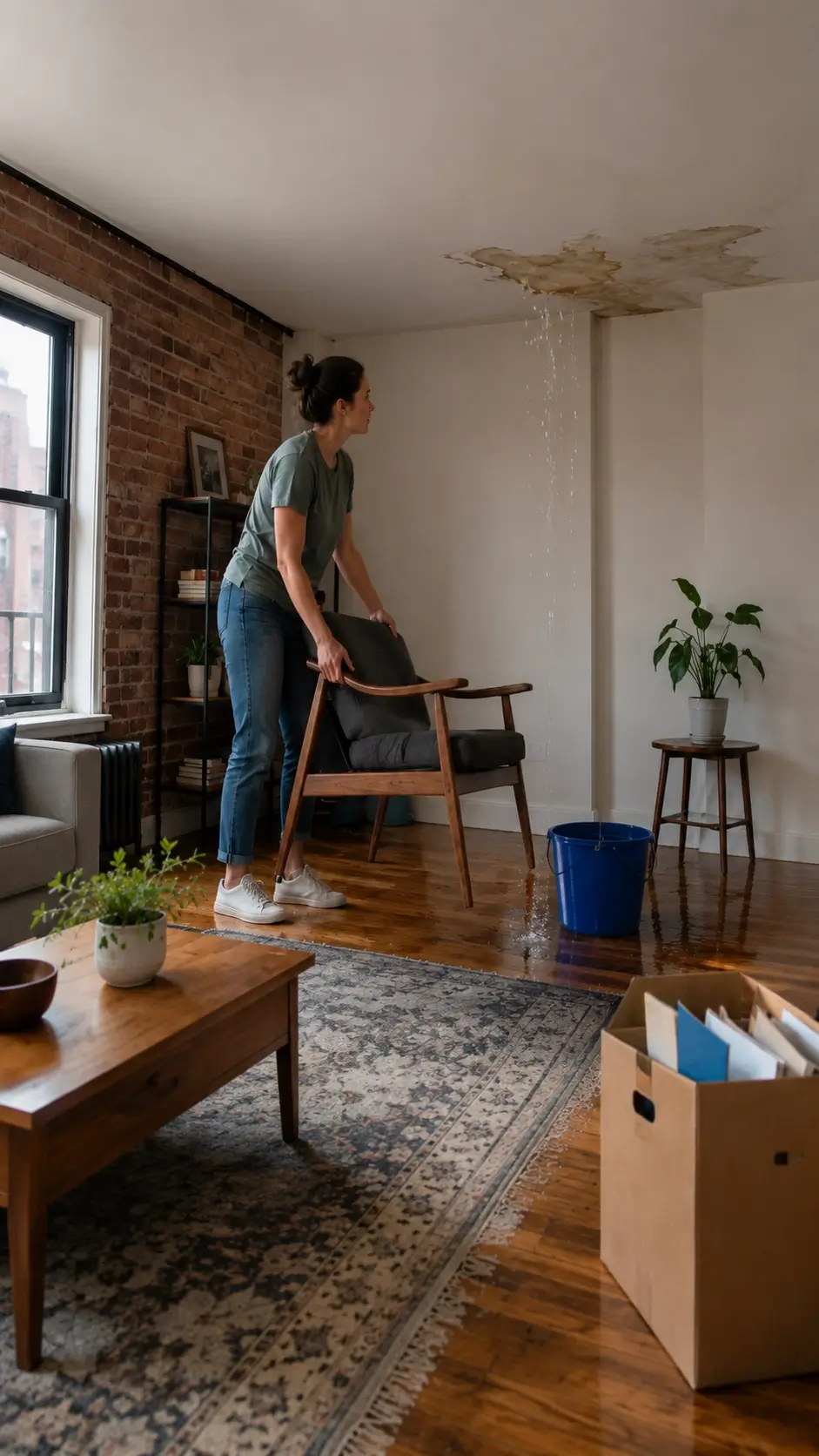
Protect people and the interior while a qualified roofing professional addresses the exterior source.
1
Stay off a wet or storm-damaged roof.
Slippery surfaces, ponding water, loose materials, electrical equipment, and concealed weak areas can make roof access unsafe.
2
Move people and belongings away from the leak.
Protect furniture, electronics, documents, rugs, and other movable contents when this can be done safely.
3
Use containers only beneath a stable ceiling.
Do not stand beneath bulging drywall, sagging plaster, or a ceiling holding trapped water.
4
Do not puncture the ceiling.
Water may be near wiring, light fixtures, weakened materials, or a larger concealed pocket.
5
Avoid electrical fixtures and switches.
Keep away from wet outlets, ceiling lights, panels, appliances, and extension cords.
6
Notify the owner or building manager.
Roof access, drain clearing, exterior repairs, and work in common assemblies may require management authorization.
7
Call a roofer and Water Damage Restoration NYC.
The roofing trade handles the exterior failure. Our team addresses the interior water, affected materials, drying, and repair scope.
Take photographs of the visible ceiling, wall, flooring, and belongings when it is safe. Do not delay emergency action to collect documentation.
ROOF, FLASHING + DRAIN ENTRY
How Roof, Flashing, Parapet or Roof-Drain Entry Causes Water Damage
The interior stain may not be directly below the exterior entry point.
Roof and Flashing Entry Points
Rainwater can enter through:
- Damaged roof membranes
- Open seams or failed patches
- Flashing around penetrations
- Parapet and coping defects
- Roof-edge transitions
- Skylights and rooftop openings
These defects can admit water above a ceiling or wall even when the first interior stain appears elsewhere.
Drainage and Low-Area Entry Points
Additional entry conditions include:
- HVAC or vent penetrations
- Cracks near masonry interfaces
- Blocked or overflowing roof drains
- Failed scuppers or drainage connections
- Ponding water around low areas
A blocked drain can allow water to collect on a low-slope roof. Water may then enter through a seam, penetration, parapet connection, or another vulnerable part of the roof assembly.
Why the Interior Stain Can Be Offset
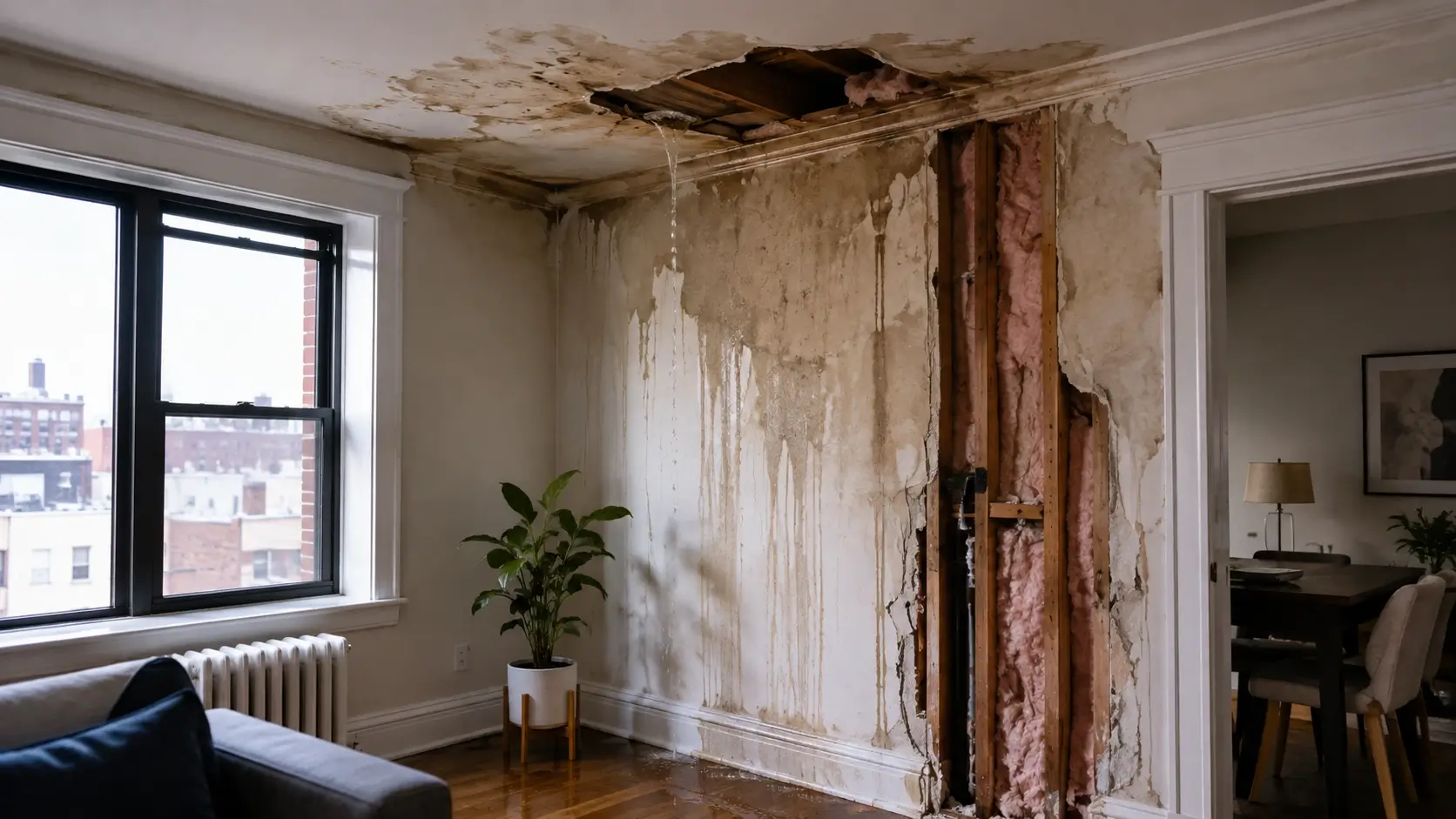
Once inside, it can move across the roof deck, follow joists, travel through insulation, or run down a wall before appearing as a ceiling stain.
The restoration inspection follows that route instead of assuming the darkest mark is directly beneath the exterior failure.
Water Condition Changes Indoors
Water entering from outdoors may also carry dirt, roof residue, microorganisms, and other contaminants.
Its condition is evaluated from the actual materials and surfaces contacted—not from the rain source alone.
ROOF-TO-INTERIOR MOISTURE PATH
Where the Water Usually Travels
The restoration boundary follows the moisture path rather than the visible stain.
First Affected Area
The first affected interior area is often the assembly directly below or beside the roof entry. We inspect:
- Roof-deck underside where accessible
- Top-floor ceilings
- Ceiling insulation
- Wall tops
- Parapet-side walls
- Rooftop bulkheads
- Skylight or penetration openings
- Utility or mechanical spaces
A stain may remain small while insulation and the upper side of the ceiling hold a wider moisture load.
Hidden Cavities
Roof water can remain inside:
- Ceiling cavities
- Insulation
- Plaster and wood-lath assemblies
- Drywall systems
- Wall framing
- Masonry interfaces
- Parapet walls
- Pipe or mechanical chases
- Layered roof or terrace assemblies
Moisture readings, thermal patterns, inspection openings, and access from adjoining areas may be used to define the affected boundary. Thermal imaging can identify temperature differences requiring verification. It does not identify the exact roof defect or prove by itself that a material is wet.
Floor Below
Water entering a top-floor ceiling can continue down a wall cavity, chase, stair enclosure, or framing connection. Lower levels may show:
- Wall staining
- Wet trim or baseboards
- Ceiling damage beside a partition
- Moisture around fixtures
- Damp flooring
- Damage inside an apartment or commercial unit below
Each affected floor should be inspected separately rather than assuming the water stopped at the first visible ceiling.
Adjacent Rooms
Water can move horizontally before gravity redirects it downward. We may inspect adjoining rooms when they share:
- A continuous ceiling cavity
- Roof-deck framing
- A parapet wall
- Continuous insulation
- A plumbing or mechanical chase
- Flooring or wall assemblies below the leak
The strongest odor or darkest stain does not always mark the full moisture footprint.
Trace the Roof-to-Interior Path
The inspection connects the suspected exterior entry to the roof deck, ceiling, insulation, wall cavities, adjacent rooms, and lower floors using documented moisture findings.
CLEAR SCOPE BOUNDARIES
Who Repairs the Source and Who Restores the Damage?
A qualified roofer, building-envelope contractor, or appropriate licensed trade repairs the exterior source. Water Damage Restoration NYC restores the interior damage.
Exterior Source Repair
Exterior source work may include:
- Repairing a roof membrane or seam
- Replacing defective flashing
- Repairing parapet or coping conditions
- Sealing penetrations
- Correcting skylight or bulkhead defects
- Clearing or repairing roof drains
- Correcting scuppers or drainage paths
- Testing the repaired area
- Completing required permits or building approvals
Water Damage Restoration NYC
Water Damage Restoration NYC may handle:
- Interior water-damage assessment
- Moisture mapping
- Accessible water removal
- Protection of unaffected rooms
- Selective ceiling or wall removal
- Cavity and structural drying
- Drying monitoring
- Damage documentation
- Ceiling and interior repair planning
Interior drying cannot remain effective while rainwater continues entering. The exterior source must be repaired, temporarily controlled, or protected before final drying and finished repairs proceed.
CONTROLLED RECOVERY SEQUENCE
Restoration Plan: Separate Roofing Repair From Interior Extraction, Cavity Drying and Ceiling Restoration
1
Confirm Exterior Response
We establish whether a roofer, building manager, or other responsible party has inspected and controlled the exterior source.
2
Map the Interior Moisture Path
The inspection covers the visible stain, adjoining ceiling, wall cavities, insulation, adjacent rooms, and lower floors where the building configuration supports further movement.
3
Remove Accessible Water
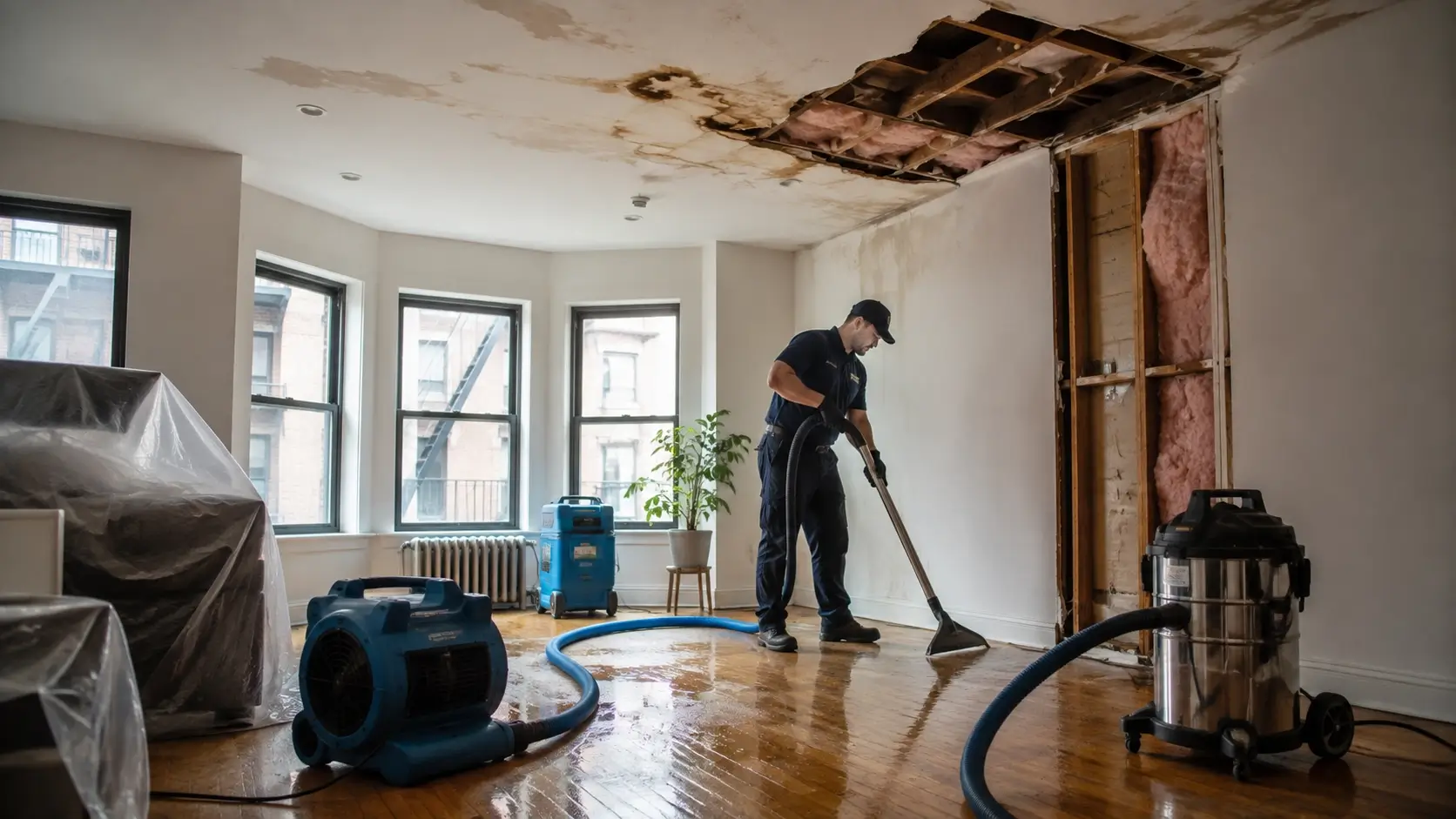
Water on floors and other accessible surfaces is extracted. Containers and wet contents are removed from the affected area.
4
Open Assemblies When Required
Limited ceiling or wall access may be needed to remove wet insulation, release trapped water safely, inspect framing, or create an effective drying path.
5
Evaluate Materials
Deteriorated drywall, unstable plaster, saturated insulation, damaged ceiling tiles, and swollen composite materials may require removal. Stable wood, masonry, or plaster may remain suitable for controlled drying.
6
Dry Retained Assemblies
Air movement and dehumidification are planned around the affected cavity, material type, room conditions, and exterior humidity.
7
Verify Drying
Material readings are monitored until retained components reach the established drying condition. A faded stain or dry surface is not sufficient proof that the cavity is dry.
8
Define Ceiling and Interior Repairs
After drying, the handoff identifies drywall, plaster, insulation, trim, paint, flooring, or other finishes requiring repair.
MATERIAL-SPECIFIC DECISIONS
Materials Commonly Affected
Drywall ceilings
Roof-leak concern: Sagging, softening and concealed moisture
Possible restoration decision: Secure, selectively remove, dry or replace
Plaster ceilings
Roof-leak concern: Deep moisture and separation from lath
Possible restoration decision: Monitor, dry or repair unstable sections
Insulation
Roof-leak concern: Saturation above ceilings or inside walls
Possible restoration decision: Remove when wet or inaccessible
Wood framing
Roof-leak concern: Moisture held around joists and wall plates
Possible restoration decision: Expose where necessary and dry
Ceiling tiles
Roof-leak concern: Staining, loss of shape and contamination
Possible restoration decision: Replace affected tiles
Hardwood flooring
Roof-leak concern: Water arriving through walls or lower levels
Possible restoration decision: Dry, monitor or repair
Wall finishes
Roof-leak concern: Peeling paint, bubbling and staining
Possible restoration decision: Dry before refinishing
Masonry
Roof-leak concern: Moisture around parapets and party walls
Possible restoration decision: Inspect and dry according to material
Electrical fixtures
Roof-leak concern: Exposure beneath the roof entry
Possible restoration decision: Refer for qualified evaluation
Personal contents
Roof-leak concern: Dripping, staining and moisture transfer
Possible restoration decision: Protect, clean, relocate or document
Final decisions depend on exposure duration, water condition, material stability, accessibility, and drying response.
A Brooklyn Roof Leaks Project
A cause-matched roof-leak project should connect the exterior entry point to the complete interior moisture path.
Consider rain entering around a parapet or blocked roof-drain area above a top-floor Brooklyn apartment. Water moves across part of the roof deck, wets ceiling insulation, appears near an exterior wall, and then continues into an adjoining room.
The project record should include:
- Weather and discovery conditions
- Suspected and confirmed exterior source
- Roofer or building-management response
- Initial ceiling and wall conditions
- Moisture readings by room
- Insulation or ceiling material removed
- Adjacent and lower areas inspected
- Drying progress
- Final ceiling-repair boundary
Kings County had an estimated 1,141,824 housing units in 2025, while only 29.5% of occupied units were owner-occupied during 2020–2024. In practice, a Brooklyn roof leak may require coordination among tenants, landlords, superintendents, property managers, condo boards, co-op boards, roof contractors, and occupants below the source.
This is Water Damage Restoration NYC’s project-evidence standard, not a fabricated customer case study. Add a real address, readings, photographs, review, timeline, or outcome only when verified evidence is available.
Insurance Documentation for This Cause
Roof-leak documentation should connect the exterior source with the resulting interior damage.
Our project record can include:
- Date and weather context
- Suspected roof-entry area
- Roofer or building-response status
- Initial photographs
- Rooms and floors inspected
- Ceiling, wall, and flooring conditions
- Moisture-reading locations
- Materials removed or retained
- Drying records
- Interior repair requirements
Water Damage Restoration NYC documents the observed property condition and restoration work. The insurer determines coverage, exclusions, maintenance-related issues, deductibles, authorization, and payment.
SCOPE BOUNDARIES
What the Service Includes and Does Not Include
Roof-Leak Restoration Can Include
- Emergency interior water-damage assessment
- Roof-to-interior moisture tracing
- Accessible water extraction
- Ceiling and wall-cavity inspection
- Adjacent-room and lower-floor checks
- Selective wet-material removal
- Structural and cavity drying
- Photographs and moisture records
- Ceiling-repair scope handoff
Not Automatically Included
- Roof membrane or flashing repair
- Parapet, coping, or masonry repair
- Roof-drain or leader repair
- Rooftop access equipment
- Electrical safety certification
- Lead or asbestos testing
- Mold remediation under a separate scope
- Major reconstruction
- Insurance coverage or claim approval
Final inclusions depend on the roof source, water condition, affected materials, property access, number of rooms or units, and inspection findings.
EVIDENCE-LED RESPONSE
Why Choose Water Damage Restoration NYC?
01
We Trace Water Beyond the Ceiling Stain
The inspection follows roof-deck, ceiling, wall, adjacent-room, and lower-floor pathways.
02
Exterior Repair and Interior Restoration Stay Separate
The roofing trade repairs the building envelope. We handle the interior water, affected materials, drying, and repair handoff.
03
Drying Is Verified Before Ceiling Repair
Wet insulation and concealed assemblies are addressed before stains are covered or ceilings are closed.
04
The Response Is Organized for Brooklyn Properties
Water Damage Restoration NYC serves properties throughout NYC, while this service is focused on roof-leak water damage in Brooklyn apartments, brownstones, multifamily buildings, private homes, and commercial properties.
Our estimated arrival is 1–2 hours, subject to traffic, weather, roof and building access, parking, and current emergency demand.
ROOF-LEAK WATER DAMAGE QUESTIONS
Frequently Asked Questions
Move people and belongings away from the affected area, avoid wet electrical fixtures and unstable ceilings, notify building management, and call a roofer plus Water Damage Restoration NYC.
Do not climb onto a wet roof or puncture a bulging ceiling.
A qualified roofer or appropriate building-envelope trade repairs the membrane, flashing, parapet, penetration, drain, or other exterior source.
Water Damage Restoration NYC handles the resulting interior water damage and drying.
We use the leak history, visual inspection, moisture readings, thermal patterns, cavity access, and checks in adjacent rooms or lower floors.
The moisture boundary follows the building assembly rather than only the visible discoloration.
Saturated insulation, unstable drywall, damaged ceiling tiles, and deteriorated plaster may require removal.
Stable framing, masonry, plaster, and other materials may remain suitable for controlled drying when their condition and readings support retention.
Yes. Documentation can include weather context, the reported source, roofing-response status, photographs, moisture readings, removed materials, drying progress, and repair requirements.
The insurance carrier makes the final coverage and payment decisions.
Stop Roof Water Before It Spreads Through Ceilings and Walls
A roof or drain failure can move water beyond the top-floor stain and into insulation, wall cavities, adjacent rooms, and lower units.
Call Water Damage Restoration NYC at +19172034372 for roof leak and roof-drain water damage cleanup in Brooklyn. We will confirm the estimated 1–2 hour arrival, trace the interior moisture path, and establish the extraction, drying, and ceiling-repair plan.
Emergency Service Form
Enter the property and callback details needed for first-call triage.
Connect and test this Elementor Pro form before publishing.