WATER DAMAGE RESTORATION NYC
Appliance Leak Water Damage Cleanup in Brooklyn
Water Damage Restoration NYC provides appliance leak cleanup in Brooklyn after dishwasher, washing machine, refrigerator, or supply-line failures. We trace water beneath cabinets and flooring, inspect adjacent rooms and the ceiling below, and begin verified drying, with an estimated 1–2 hour arrival.
- 24/7 Emergency Service
- Certified Team
- Rapid Response
- Insurance Assistance
Appliance-Leak Service Commitments
●
1–2 Hour
Estimated Arrival
●
Appliance-to-Damage
Inspection
●
Cabinet and Flooring
Moisture Mapping
●
Documented
Drying and Repair Handoff
IMMEDIATE SAFETY ACTIONS
Immediate Actions After Appliance Leaks
Stop the appliance and water supply when the controls are safe to reach.
1
Turn off the appliance.
Do not continue a wash, rinse, drain, or ice-making cycle to identify where the water is coming from.
2
Close the appliance supply valve.
Washing machines, dishwashers, and refrigerators may have a nearby shutoff valve. Close it only when you can reach it without stepping into water near electricity.
3
Use the house control valve when necessary.
NYC311 states that property owners can temporarily close the house control valve to stop water while a leak is repaired. A plumber should restore the supply after the repair is complete.
4
Do not unplug or move a wet appliance.
Water may be beneath the unit or near an outlet, cord, motor, heating element, or electrical connection.
5
Protect dry belongings.
Move rugs, boxes, documents, food products, and small furniture away from the water path when it is safe.
6
Notify the superintendent or property manager.
In a Brooklyn apartment, condo, co-op, or mixed-use building, water may have entered a neighboring unit or common assembly.
7
Photograph the source area.
Record the appliance, supply or drain connection, visible water, cabinets, flooring, baseboards, and ceiling below before materials are moved.
Call an appliance technician or licensed plumber for source repair. Call Water Damage Restoration NYC for the released water, hidden moisture, affected materials, drying, and interior restoration scope.
APPLIANCE FAILURE SOURCES
How Washer, Dishwasher, Refrigerator or Supply-Line Failure Causes Water Damage
Appliances can release water suddenly or slowly.
A disconnected washing-machine hose may discharge a large volume within a short period. A refrigerator icemaker line may leak behind the unit for days before flooring or cabinets show damage. Washing-machine supply hoses connect directly to the building water supply, and a failed hose can cause extensive interior flooding when no one is present.
Washing-Machine Failures
Water may come from:
- Hot- or cold-water supply hoses
- Loose or failed hose connections
- Drain hoses
- Pumps or internal tubing
- Door seals
- Overflow or drainage problems
- Laundry sink or shared drain backups
A pressurized supply-hose failure can continue releasing water until the valve is closed. A drain-side release may contain detergent, soil, lint, and residue.
Dishwasher Failures
Common source areas include:
- Supply-line connections
- Drain hoses
- Door seals
- Pumps and internal components
- Overflow conditions
- Sink or garbage-disposal connections
Dishwasher water can collect beneath the appliance and cabinet toe kick before it reaches the visible kitchen floor.
Refrigerator Failures
Refrigerator-related water may come from:
- Icemaker supply tubing
- Water-dispenser lines
- Supply valves
- Filter housings and connections
- Drain or defrost components
A slow refrigerator leak can remain hidden behind the appliance, cabinets, or finished flooring. The first sign may be a swollen floor seam, stained baseboard, soft cabinet panel, or ceiling mark below.
Appliance Supply-Line Failures
A failed supply connection may release relatively clean water at the source, but its condition can change after contacting food residue, detergent, dirty cavities, flooring layers, or stored materials.
Water damage may be gradual or sudden and can affect wood, composite products, laminated materials, metal components, flooring, drywall, and electrical systems.
MOISTURE MIGRATION
Where the Water Usually Travels
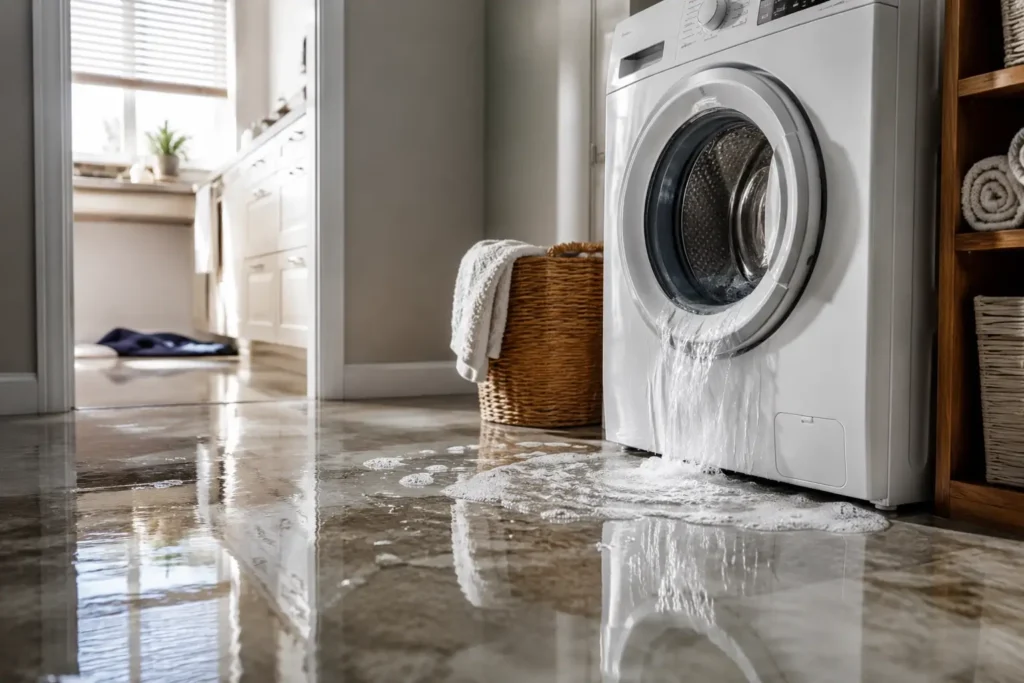
The appliance location is only the starting point. Water follows floor slope, cabinet openings, wall plates, seams, utility penetrations, and gravity.
First Affected Area
We inspect directly beneath and behind the appliance. That area may include:
- Cabinet toe kicks
- Appliance recesses
- Supply and drain connections
- Finished flooring
- Underlayment
- Wall bases
- Nearby outlets
- Floor penetrations
The appliance may need to be moved by the appropriate technician before the full condition can be seen.
Hidden Cavities
Water can enter:
- The void beneath cabinets
- Wall cavities around supply or drain lines
- Insulation
- Subfloor seams
- Flooring adhesive
- The space beneath raised or floating flooring
- Plumbing penetrations between floors
A dry-looking tile or plank surface does not establish that the underlayment or subfloor is dry. EPA guidance notes that moisture problems often remain out of sight beneath flooring or behind finished surfaces and that wet materials must be dried before they are enclosed again.
Floor Below
Water from a kitchen or laundry appliance can move through subfloor joints, pipe openings, framing gaps, and ceiling cavities. The lower level may show:
- Ceiling stains
- Dripping around a light fixture
- Moisture at the top of a wall
- Sagging drywall or plaster
- Wet insulation
- Damage several feet from the appliance above
The ceiling below should be inspected even when most visible water remains in the appliance room.
Adjacent Rooms
Water can move under continuous flooring and cross beneath a doorway before it appears. We check:
- Hallways
- Pantries and closets
- Rooms sharing the appliance wall
- Flooring transitions
- Baseboards
- Cabinet ends
- Lower apartments or commercial units
Confirmed Moisture Defines the Boundary
The final boundary follows confirmed moisture rather than the edge of the visible puddle.
CLEAR SCOPE BOUNDARIES
Who Repairs the Source and Who Restores the Damage?
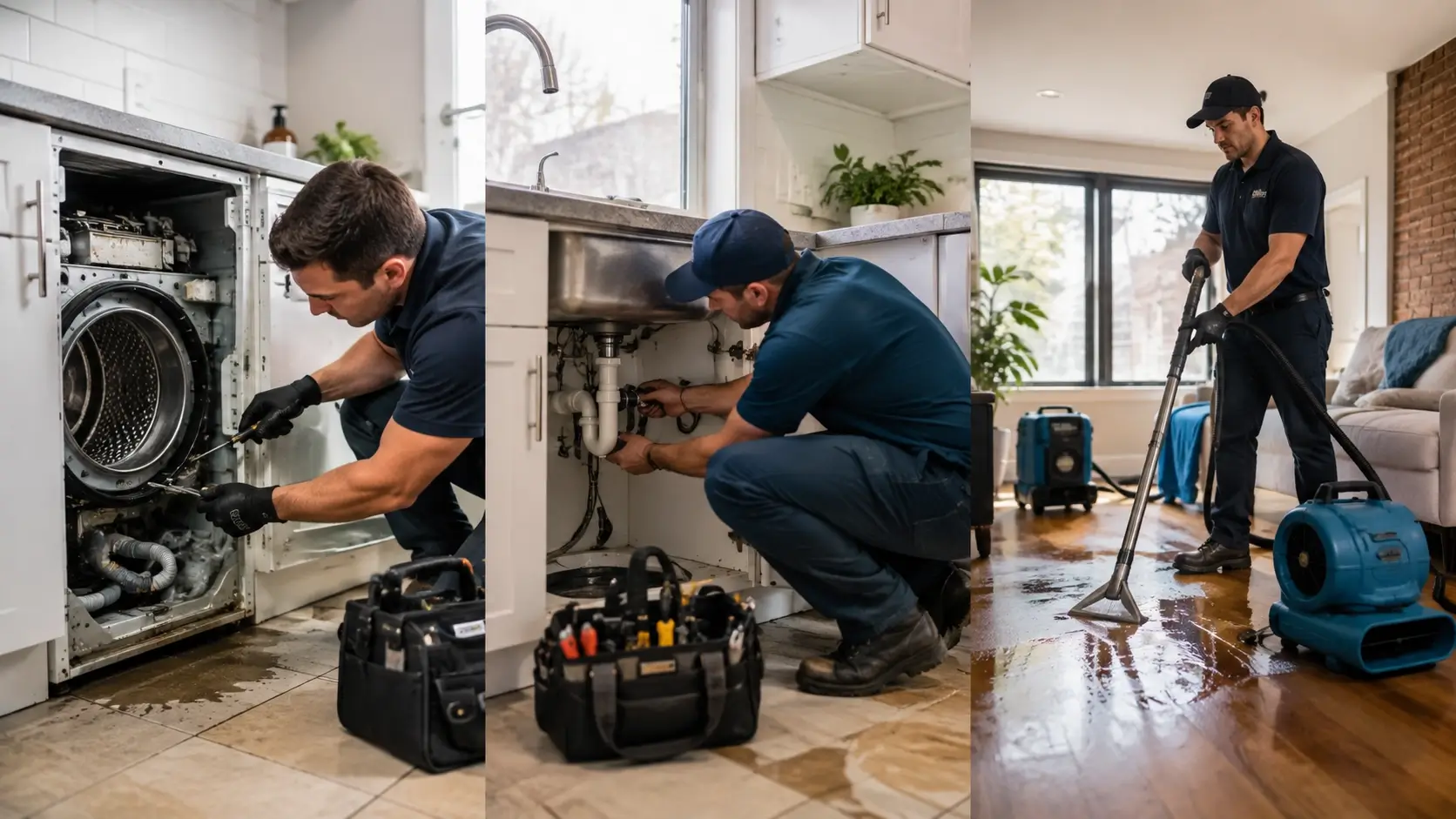
An appliance technician or licensed plumber repairs the failed appliance or water connection. Water Damage Restoration NYC restores the resulting property damage.
Appliance Technician
An appliance technician may handle:
- Internal pumps
- Door seals
- Filters
- Defrost components
- Internal hoses
- Appliance-specific drainage parts
Licensed Plumber
A licensed plumber may handle:
- Supply valves
- Building water lines
- Drain connections
- Failed fittings
- Branch piping
- Permanent shutoff repairs
Water Damage Restoration NYC
Water Damage Restoration NYC may handle:
- Water-damage inspection
- Moisture mapping
- Standing-water extraction
- Protection of unaffected areas
- Selective material removal
- Structural drying
- Drying documentation
- Interior repair planning
We do not represent water extraction or cabinet drying as permanent appliance or plumbing repair.
CONTROLLED RECOVERY SEQUENCE
Restoration Plan: Inspect Cabinetry, Flooring, Adjacent Rooms and the Ceiling Below
1
Confirm Source Control
We confirm that the appliance has stopped operating and that the water supply or discharge source has been isolated.
2
Coordinate Source Repair
The appliance technician or plumber identifies and repairs the failed component. Their access requirements are coordinated with the restoration scope.
3
Inspect the Appliance Recess and Cabinetry
Moisture checks extend behind toe kicks, end panels, cabinet backs, adjacent walls, and accessible flooring edges.
4
Trace Flooring Migration
We examine the finished floor, underlayment, subfloor, door transitions, and connected rooms. Hardwood, laminate, tile, vinyl, and carpet require different decisions.
5
Inspect the Ceiling Below
Lower ceilings, walls, fixtures, and flooring are checked where the building configuration allows water to travel downward.
6
Extract Accessible Water
Standing water and water held in suitable floor coverings are removed. Extraction does not prove that cabinets, subflooring, or wall cavities are dry.
7
Remove Unsalvageable Material
Wet insulation, deteriorated drywall, damaged padding, and swollen composite cabinet components may require selective removal.
8
Dry and Monitor Retained Assemblies
Equipment placement follows the moisture map. Material readings are recorded until retained assemblies reach the established drying condition.
9
Define Interior Repairs
After drying, the handoff identifies flooring, trim, drywall, paint, cabinets, or ceiling finishes requiring restoration.
MATERIAL-SPECIFIC DECISIONS
Materials Commonly Affected
Cabinet toe kicks
Appliance-leak concern: Concealed saturation and swelling
Possible restoration decision: Detach, dry or replace
Particleboard cabinets
Appliance-leak concern: Loss of strength and delamination
Possible restoration decision: Replace affected components
Hardwood
Appliance-leak concern: Cupping and wet subflooring
Possible restoration decision: Extract, dry, monitor or replace
Laminate
Appliance-leak concern: Swollen seams and fiber-core damage
Possible restoration decision: Replace affected sections
Tile flooring
Appliance-leak concern: Water beneath grout, tile or underlayment
Possible restoration decision: Inspect and dry supporting assembly
Vinyl flooring
Appliance-leak concern: Trapped water and adhesive failure
Possible restoration decision: Lift, dry or replace as required
Carpet and padding
Appliance-leak concern: Water held beneath the surface
Possible restoration decision: Extract and assess padding separately
Drywall or plaster
Appliance-leak concern: Moisture at wall bases or ceiling below
Possible restoration decision: Dry, selectively open or repair
Insulation
Appliance-leak concern: Saturation inside a wall or ceiling
Possible restoration decision: Remove when wet or inaccessible
Electrical components
Appliance-leak concern: Exposure near outlets or appliances
Possible restoration decision: Refer for qualified evaluation
The final decision depends on the water source, exposure time, contamination, physical damage, accessibility, and drying response.
SCOPE BOUNDARIES
What the Service Includes and Does Not Include
Appliance-leak cleanup can include
- Emergency water-damage assessment
- Source-to-damage moisture tracing
- Standing-water extraction
- Cabinet and flooring inspection
- Adjacent-room and lower-floor inspection
- Selective wet-material removal
- Structural drying and monitoring
- Photographs and moisture records
- Interior repair-scope handoff
Not automatically included
- Internal appliance repair
- Permanent plumbing repair
- Appliance replacement
- Electrical safety certification
- Food or product replacement
- Lead or asbestos testing
- Mold remediation under a separate scope
- Major reconstruction
- Insurance coverage or claim approval
Final inclusions depend on the appliance, failure type, water category, affected materials, access, number of rooms or units, and inspection findings.
EVIDENCE-LED RESPONSE
Why Choose Water Damage Restoration NYC?
01
We Inspect Beyond the Appliance
The assessment covers the appliance recess, cabinet voids, flooring layers, adjacent rooms, and ceiling below.
02
Source Repair and Restoration Stay Separate
The appliance technician or plumber repairs the failure. We handle the released water, affected materials, drying, and interior handoff.
03
Drying Is Verified by Material
Equipment is removed according to recorded moisture conditions—not because the visible puddle is gone.
04
The Response Is Organized for Brooklyn Properties
Water Damage Restoration NYC serves properties throughout NYC, while this service is focused on appliance leak cleanup in Brooklyn homes, apartments, brownstones, multifamily buildings, and commercial properties.
Our estimated arrival is 1–2 hours, subject to traffic, weather, parking, building access, and current emergency demand.
APPLIANCE-LEAK WATER DAMAGE QUESTIONS
Frequently Asked Questions
Stop the appliance, close its safe and accessible supply valve, and call an appliance technician or plumber plus Water Damage Restoration NYC.
Do not move or unplug wet electrical equipment while standing in water.
An appliance technician repairs internal appliance components, while a licensed plumber may repair supply valves, water lines, fittings, or drain connections.
Water Damage Restoration NYC restores the resulting water damage.
We use the loss history, visual inspection, moisture readings, thermal patterns, accessible flooring edges, cabinet openings, and checks in adjoining or lower rooms.
Thermal patterns guide the inspection but require direct moisture verification.
Wet insulation, damaged padding, deteriorated drywall, swollen laminate, and composite cabinet components may require removal.
Wood, plaster, tile assemblies, and subflooring may remain suitable for drying depending on their condition and readings.
Yes. Documentation can include the appliance and failure point, migration route, photographs, moisture readings, affected materials, drying progress, and repair requirements.
The insurer makes the final coverage and payment decisions.
REQUEST EMERGENCY RESPONSE
Stop Appliance Water Before It Spreads Beyond the Kitchen or Laundry Area
Water from a dishwasher, washing machine, refrigerator, or supply line can move beneath cabinets, through flooring, and into the room or apartment below.
Call Water Damage Restoration NYC at tel:+19172034372 for appliance leak cleanup in Brooklyn. We will confirm the estimated 1–2 hour arrival, trace the appliance-to-damage path, remove accessible water, and establish the drying and repair plan.
Emergency Service Form
Connect and test this Elementor Pro form before publishing.